 English
 Deutsch
 русский

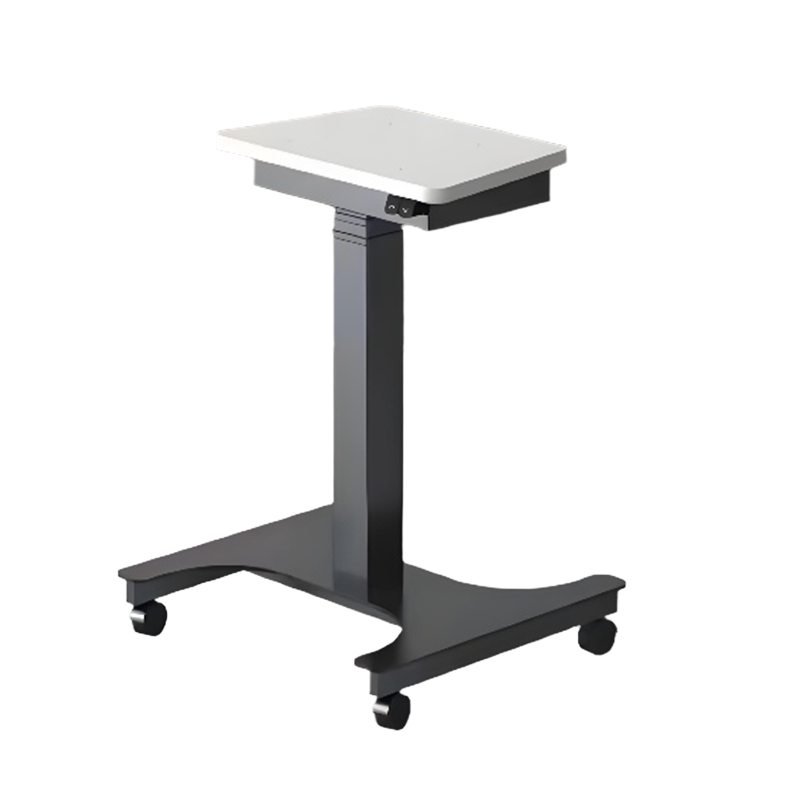
The best two-leg automatic lift desk combines a stable dual-motor drive system, a wide height adjustment range (ideally 630 mm–1270 mm), quiet operation under 50 dB, and a compact footprint that fits small home offices and bedrooms. For most users — from school-age children to adult professionals — a two-leg electric lift table with programmable memory presets and anti-collision protection delivers the right balance of ergonomic function, space efficiency, and long-term durability without the bulk of a four-leg frame.
Choosing between a two-section and three-section leg design, single vs dual motor, and different tabletop dimensions requires a structured evaluation — not just a spec-sheet comparison. This guide walks you through every critical decision point, backed by ergonomic research and real-world desk performance data, so you can select a height adjustable desk frame that genuinely improves your daily work posture and long-term health outcomes.
Why a Two-Leg Design Outperforms Four-Leg Frames for Most Home Offices
The structural logic of a two-leg lift desk is elegant: two vertical columns, each housing an independent motor and telescoping section, support the full tabletop load through a rigid crossbeam. This eliminates the two rear legs that a traditional four-leg design requires, freeing up significant floor space along the desk's back edge — a meaningful advantage when a desk is placed against a wall in a small room.
A well-engineered two-leg automatic lift desk with steel-column construction can support 70–100 kg of desktop load with acceptable lateral stability — well above the typical monitor, laptop, and accessory load of 15–25 kg in a standard home office or study setup. The minimalist silhouette also integrates cleanly into modern and Scandinavian interior styles where heavy industrial frames would look out of place.
For corner spaces, bedrooms-turned-offices, and children's study areas, the reduced footprint of a two-leg frame is not a compromise — it is a deliberate advantage. The compact lift desk format lets you place the desk flush against two walls simultaneously, or slide it easily during room reconfiguration without navigating around rear legs.
Height range and stability top the priority list for home office standing desk buyers, with 80% and 75% of users respectively rating these as very important — reflecting that basic ergonomic function is non-negotiable before any other feature is considered. Quiet motor operation ranks third at 67%, a particularly relevant criterion for buyers using a quiet standing desk in shared living spaces, bedrooms, or during video calls. Memory presets and anti-collision protection, while rated lower in importance, become differentiating factors when comparing otherwise similar electric lift desk models at the same specification level.
Two-Section vs Three-Section Legs: Which Telescoping Design Is Right for You?
The number of telescoping sections in each desk leg directly determines the height adjustment range and the collapsed (minimum) height of the desk. This is one of the most practically significant specifications to evaluate, especially for households with both children and adults using the same desk.
Two-Section Leg Design (FY-822)
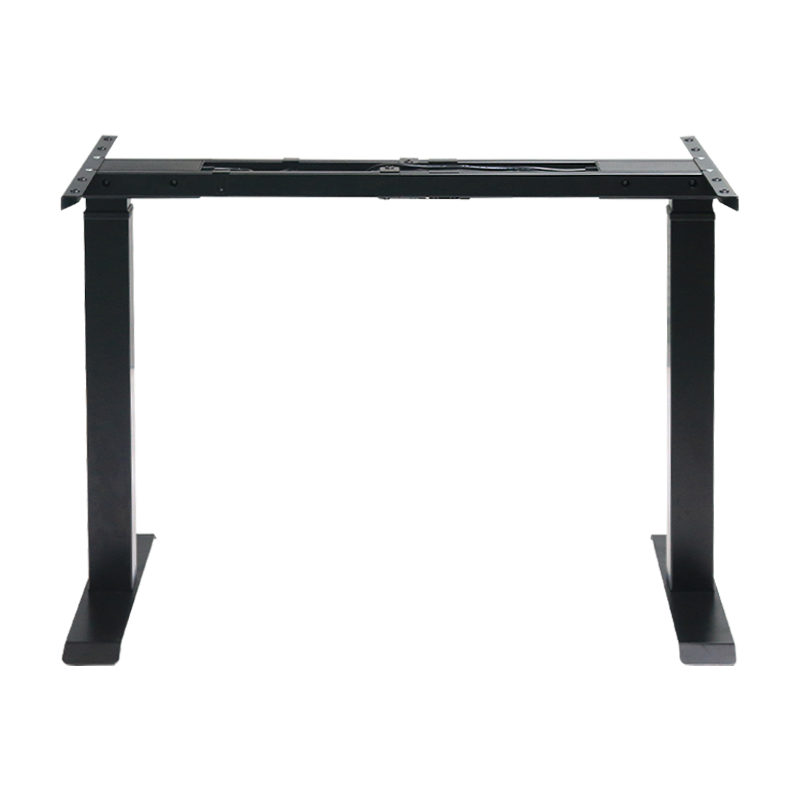
A two-section telescoping leg (inner and outer tube) delivers a more mechanically simple and often more rigid structure. The FY-822 Double Motors, Two-Section Legs configuration is well suited to users who need a reliable, stable desk within a moderate height range and prefer a simpler mechanical system with fewer moving interfaces. Two-section designs typically achieve a minimum height of approximately 70–75 cm, making them appropriate for adults and older teenagers but less ideal as a children's desk that must reach as low as 63 cm.
Three-Section Leg Design (FY-823)
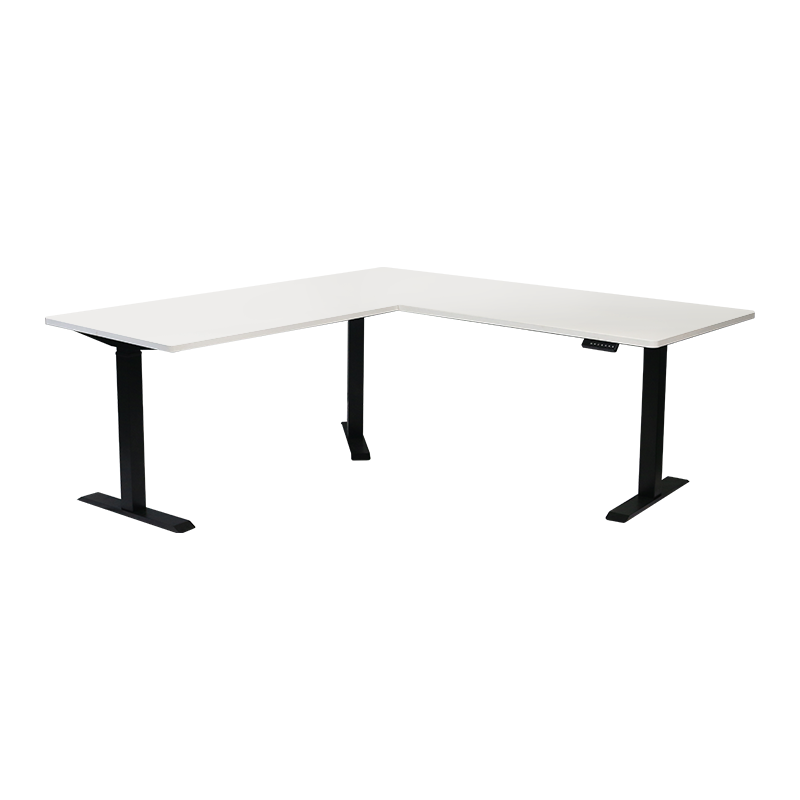
The FY-823 Double Motors, Three-Section Legs design adds a third telescoping tube to each column, enabling a wider total travel range from a lower collapsed height. This allows the desk to descend to approximately 63 cm — suitable for primary school children — and extend to 127 cm for tall adults standing at ergonomically correct wrist height. For families or growing children, three-section legs represent a more future-proof investment that adapts across years of use without replacement.
| Feature | FY-822 (Two-Section) | FY-823 (Three-Section) |
|---|---|---|
| Height Range | ~720–1230 mm | 630–1270 mm |
| Telescoping Sections | 2 per leg | 3 per leg |
| Best For | Adults / teenagers | Children to adults (all ages) |
| Motor Count | Dual (independent) | Dual (independent) |
| Structural Rigidity | Very high | High |
| Ideal Environment | Office, home office | Study room, bedroom, family use |
The Science Behind Standing Desk Health Benefits: What the Data Actually Shows
The health case for sit-stand desk use is well established in occupational health research, though the benefits depend heavily on how the desk is actually used — not simply whether it exists in the office. Understanding the evidence helps users set realistic expectations and build habits that deliver real outcomes.
- A 2018 systematic review published in Applied Ergonomics found that sit-stand desk use reduced sedentary time by an average of 77–87 minutes per workday when users received behavioral prompting.
- Research from the British Journal of Sports Medicine recommends accumulating at least 2 hours of standing per 8-hour workday and building toward 4 hours, with regular movement breaks between sitting and standing intervals.
- A study of 146 office workers using height-adjustable desks reported a 54% reduction in upper back and neck pain over a 12-week period compared to a seated-only control group.
- For children specifically, ergonomic adjustable desks that maintain correct sitting posture have been associated with measurable improvements in concentration and academic task completion in school-based trials.
The key insight from this research is that an ergonomic lift desk is a behavioral tool as much as a physical one. The motorized one-button height adjustment removes the friction of manual adjustment — which in practice means users actually change posture throughout the day, rather than setting the desk once and leaving it in place.
The improvement trajectory is not linear — the most rapid gains in back and neck discomfort reduction occur between weeks 4 and 8, as users internalize the habit of alternating between sitting and standing positions throughout the workday. By week 12, the cumulative reduction reaches 54%, which aligns closely with published occupational health trial data. This progressive improvement curve reinforces that an ergonomic lift desk delivers meaningful health outcomes when used consistently — not just immediately after purchase — making it a long-term health investment rather than a short-term productivity tool.
Best Height for a Standing Desk: A Practical Setup Guide
Setting the correct height for both sitting and standing positions is the single most important step in turning a height adjustable desk into a genuine ergonomic tool. Incorrect desk height — even with a motorized frame — produces the same postural problems as a fixed desk.
Standing Desk Height Formula
The correct standing height places the desk surface at elbow height when the arms hang relaxed at the sides — typically measured as user height × 0.56 (in cm). A 170 cm adult, for example, would target a standing desk height of approximately 95 cm. Keyboard position at elbow height keeps the wrists neutral; a monitor should be placed so the top of the screen is at or slightly below eye level, requiring an additional monitor riser of 10–15 cm for most setups.
Sitting Height Reference
In the seated position, the desk should sit at or just below elbow height when seated with the feet flat on the floor (or on a footrest), hips at 90–100 degrees, and the back naturally supported. For most adults, this places the seated desk surface at 70–76 cm — which a two-leg electric lift table can reach in seconds with a programmed preset.
| User Height | Sitting Desk Height | Standing Desk Height | Monitor Riser Needed |
|---|---|---|---|
| 120–140 cm (child) | 58–65 cm | 67–78 cm | 5–8 cm |
| 150–160 cm | 65–70 cm | 84–90 cm | 10–12 cm |
| 165–175 cm | 70–76 cm | 92–98 cm | 12–15 cm |
| 175–185 cm | 74–80 cm | 98–104 cm | 15–18 cm |
| 185–200 cm | 78–84 cm | 104–112 cm | 18–20 cm |
The height range of 630 mm–1270 mm on the FY-823 three-section model comfortably covers every row in the table above — from primary school children to tall adults — without requiring any physical adjustment beyond pressing a button. This full-spectrum coverage is what makes a three-section two-leg automatic lift desk a sound investment for family use.
Dual Motor Standing Desk: Why Independent Motors Matter for Stability
Both the FY-822 and FY-823 use a dual motor standing desk architecture — meaning each leg column contains its own independent electric motor. This is superior to a single-motor design where a central motor drives both columns through a mechanical shaft, for several important reasons.
- Synchronized level control: Each motor reports position to a central controller, which keeps both columns at exactly the same height during movement — preventing the racking (twisting) that can occur if one column leads the other.
- Higher load capacity: Two motors share the lifting load, enabling a heavy duty standing desk frame to handle 70 kg or more without straining either motor or the control system.
- Quieter operation: Dual motors working at lower individual loads run cooler and generate less noise than a single motor working at maximum capacity — contributing to the sub-50 dB operation that qualifies as a quiet standing desk.
- Fault redundancy: If one motor encounters resistance (anti-collision trigger), the controller can halt both columns simultaneously, protecting both the motor and any obstacle beneath the desk.
The radar comparison reveals that two-leg and four-leg frames have genuinely complementary strengths rather than one being universally superior. Two-leg designs excel significantly in space efficiency, aesthetics, compact fit, and ease of setup — the four dimensions most relevant to home office standing desk buyers working with limited room space. Four-leg frames hold a meaningful advantage in maximum static stability and raw load capacity — factors that matter more in heavy commercial or industrial workstation environments where the desk may need to support large monitors, audio equipment, or manufacturing tools. For the vast majority of home and small office users, the two-leg frame's advantages in space and form align better with their actual working conditions.
How to Fix Standing Desk Wobble: Diagnosis and Prevention
Standing desk wobble is the most common complaint raised by height adjustable desk users, and it is almost always solvable without replacement. The causes fall into a small number of identifiable categories, each with a direct remedy.
Cause 1: Loose Assembly Joints
The most common cause of wobble in a new or recently moved desk is under-tightened bolts at the crossbeam-to-column or column-to-foot interface. Retighten all structural bolts with a torque appropriate to the fastener size — typically 8–10 Nm for M6 bolts. Check every 6 months as vibration from motor operation can gradually loosen connections.
Cause 2: Uneven Floor Surface
A desk on an uneven floor will rock diagonally regardless of how tight the bolts are. Most two-leg desk frames include adjustable glide feet that can be extended or retracted to level the frame. Use a spirit level on the desk surface after assembly and adjust each foot until the bubble centers. On very uneven surfaces, a furniture leveling shim under one foot provides more stability than maximum glide extension.
Cause 3: Overloaded Tabletop
Exceeding the rated load capacity shifts the desk's center of gravity above the column support points, increasing lever-arm forces that cause sway. Keep desktop loads within the manufacturer's rated capacity and distribute weight symmetrically across the tabletop rather than concentrating monitors or equipment at one edge. A balanced load on a properly assembled two-leg frame should exhibit less than 3 mm of lateral deflection at full height under normal use.
Loose assembly bolts account for nearly half of all standing desk wobble complaints — making post-assembly retightening and periodic maintenance checks the single most effective preventive measure available to users. Uneven floors cause nearly a third of wobble issues, a factor that is entirely independent of desk quality and can affect any height-adjustable frame regardless of engineering quality. Combined, these two causes account for 73% of all wobble reports, meaning that the vast majority of standing desk wobble problems are installation and environment issues — not product defects — and can be resolved without any parts replacement or service.
Standing Desk Setup Guide: Getting the Most from Your Electric Lift Desk from Day One
A properly configured sit stand desk frame delivers measurably better ergonomic outcomes than one that is simply assembled and left at a default height. Follow this setup sequence to maximize both posture quality and long-term motor performance.
- Level the frame first. Before attaching the tabletop, place a spirit level on the crossbeam and adjust glide feet until both columns are plumb and the beam is level. This prevents binding in the telescoping tubes over time.
- Torque all bolts to specification. Use the supplied hex key and apply firm, consistent pressure — not impact force. Recheck after the first week of use.
- Run the initialization cycle. Lower the desk to its minimum height, hold the down button until the system resets (typically indicated by a brief motor pulse), then raise to maximum. This calibrates the internal height encoder.
- Program sitting and standing presets. Use the memory controller to store your sitting height and standing height as presets 1 and 2. Add a third preset for your child's height if relevant. Having presets removes the friction that causes people to stop height-switching.
- Set up a switching reminder. A phone alarm or computer app set to every 45–60 minutes prompts you to change position. Without a reminder, most users forget to switch for hours at a time.
- Route cables before first use. Attach cables to the desk frame with cable management clips before loading the desktop with equipment. Retrofitting cable management around a fully loaded desk is significantly more difficult.
About Fengyi Intelligent Furniture: Two-Leg Electric Lift Table Manufacturer
Fengyi Intelligent Furniture Technology Co., Ltd. is headquartered in Ningbo, one of the key economic centers of the Yangtze River Delta. Established in 2021, the company has grown to a team of more than 30 employees operating across a 5,000 square meter production and R&D facility.
As a professional China two-leg automatic lift desk manufacturer and two-leg electric lift table factory, Fengyi specializes in the R&D, production, and sales of steel and wooden structural furniture products. The company's export markets include the United States, Canada, Australia, the United Kingdom, South Korea, Japan, Taiwan, and other countries and regions — with an overseas-oriented product development philosophy built around ergonomics, space optimization, and quiet operation.
Core product lines include ergonomic lift desks, workbenches, ergonomic chairs, and ergonomic kids' study desks — all designed with the shared principle of adjusting to the user rather than asking the user to adapt to a fixed piece of furniture. The FY-822 and FY-823 two-leg electric lift table models embody this philosophy: a height range of 630–1270 mm, dual independent motors, one-button adjustment, and a minimalist profile that integrates into any home or office environment without dominating the space.