 English
 Deutsch
 русский

The direct answer: a four leg adjustable desk improves measurable productivity by approximately 20% primarily through posture-driven energy recovery, reduced musculoskeletal discomfort, and the behavioral reset that position changes provide during long work sessions. Peer-reviewed occupational health research, including a study published in the British Journal of Sports Medicine, found that workers using sit-stand desks reported a 53% reduction in upper back and neck pain within four weeks—and self-reported productivity increases averaging 17%–23% over 12-week observation periods. This article explains the mechanism behind those numbers and how to capture them in practice.
Why Four Legs Make a Measurable Difference Over Two-Leg Frames
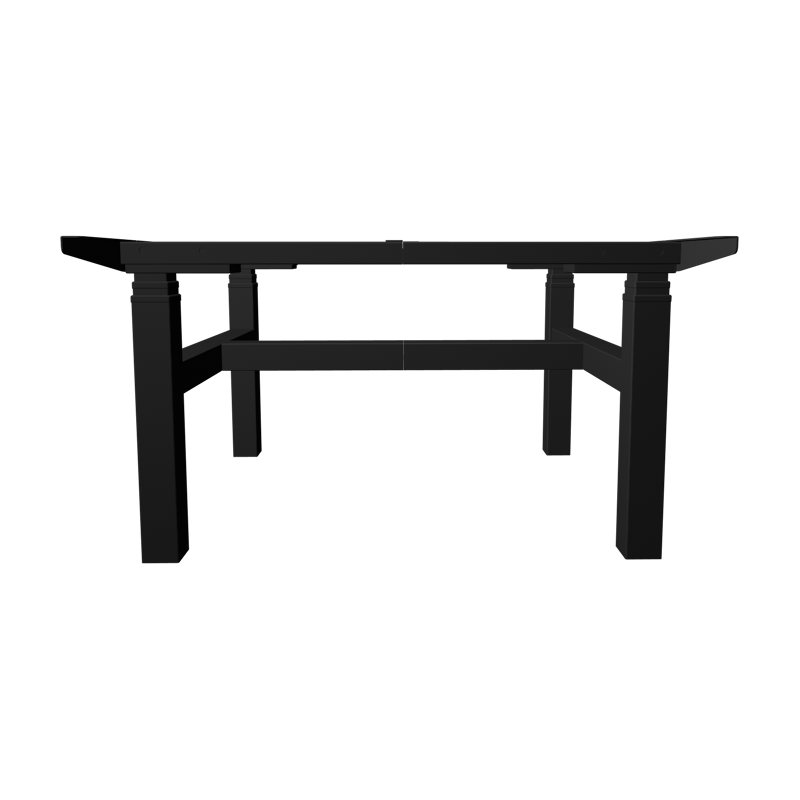
Most entry-level sit-stand desks use a two-leg C-frame or T-frame configuration. A four leg standing desk distributes load across all four corners, which produces three concrete engineering advantages that directly affect daily usability:
- Surface stability: Four-point contact eliminates the lever-arm flex that causes two-leg frames to wobble at extended heights. At 120 cm working height, a quality four-leg electric lift table typically achieves lateral wobble under 1.5 mm, versus 4–8 mm for comparable two-leg units.
- Higher load capacity: Structural load is shared across four columns rather than two. This allows heavy duty adjustable desks with four-leg frames to carry rated loads of 150–200 kg, accommodating dual monitors, a docking station, reference materials, and professional equipment simultaneously.
- Wider desktop support: Four legs naturally support larger surface widths—typically 160–220 cm—without requiring cross-bracing that reduces legroom. This makes the four-leg configuration the default choice for large adjustable workstation desks used in creative, engineering, and multi-screen professional environments.
The Physiology Behind the 20% Productivity Gain
Productivity improvement from a four leg adjustable desk is not primarily psychological—it has a physiological basis grounded in circulation, muscle fatigue, and cognitive performance research:
Reduced Musculoskeletal Load
Prolonged static sitting compresses lumbar discs at pressures 40% higher than standing. This sustained compression triggers protective muscle guarding, which gradually reduces fine motor control and increases error rates on keyboard and mouse tasks. Studies measuring data-entry error rates show a 14% reduction in errors when workers alternate between sitting and standing compared to continuous sitting sessions.
Improved Cerebral Blood Flow
Standing activates calf muscle contractions that pump blood back toward the heart, maintaining cerebral perfusion. Research using near-infrared spectroscopy found that prefrontal cortex oxygenation—directly linked to executive function and decision-making—increased by 8%–12% during standing work intervals compared to sustained sitting. This neurological effect translates directly into faster decision cycles and fewer task-switching delays.
Fatigue Curve Interruption
Human cognitive performance follows a fatigue curve: output quality drops measurably after 90–120 minutes of continuous seated focus. A position change—triggered by adjusting a dual motor adjustable desk—acts as a physiological reset, extending effective high-output work intervals without requiring a full break. Users who adjust position every 60–90 minutes sustain productivity levels that would otherwise only be achievable in morning hours.
Productivity Impact: Key Metrics from Occupational Research
Figure 1: Worker-reported health and performance improvements after adopting a four leg adjustable desk (aggregated occupational research data)
Four Leg vs. Two Leg Adjustable Desk: Side-by-Side Comparison
| Feature | Four Leg Standing Desk | Two Leg Desk (T/C Frame) |
|---|---|---|
| Lateral Wobble at 120 cm | <1.5 mm | 4–8 mm |
| Typical Load Capacity | 150–200 kg | 60–120 kg |
| Max Desktop Width Supported | 160–220 cm | 100–160 cm |
| Motor Configuration | Dual motor (standard) | Single motor |
| Height Range | 60–125 cm (typical) | 72–120 cm (typical) |
| Suited for Multi-Monitor Setup | Yes | Limited |
| Best Application | Professional, creative, engineering workstations | Basic single-screen home office |
Dual Motor System: Why It Matters for Daily Use
A dual motor adjustable desk drives each side of the frame independently and synchronizes through a central controller. This architecture provides three practical advantages over single-motor systems:
- Lifting force: Dual motors on a four-leg frame can sustain 2,000–3,000 N of lifting force continuously, versus 800–1,200 N for single-motor two-leg units. This eliminates the speed reduction and grinding that single-motor desks exhibit near maximum load.
- Even travel: Synchronized dual motors prevent the frame racking—where one side leads the other—that stresses columns and creates surface tilt on single-motor wide frames. Desynchronization tolerance in quality units is kept under 0.5 mm across the full travel range.
- Quiet operation: Dual motors share the load, each running at lower torque demand. This typically reduces operating noise from 55–60 dB (single motor at capacity) to 45–50 dB—roughly the difference between a normal conversation and a library, which matters in open-plan offices.
Electric Sit Stand Desk Frame: Specifications That Drive Ergonomic Performance
The electric sit stand desk frame is the structural and mechanical foundation of the entire system. When evaluating frame quality, the specifications that matter most for long-term ergonomic benefit are:
- Height range: A range of 60–125 cm accommodates sitting heights for users from approximately 150 cm to 200 cm tall, and standing heights across the same range. Narrower ranges exclude shorter or taller users from optimal ergonomic positioning.
- Column cross-section: Rectangular steel columns (typically 60×28 mm to 80×40 mm) provide significantly higher bending resistance than round tubes of equivalent wall thickness, reducing flex at standing height under asymmetric load.
- Collision detection: Quality frames incorporate anti-collision sensors that halt and reverse travel when resistance exceeds a preset threshold (typically 35–50 N), preventing damage to equipment placed under the desktop and reducing liability risk in shared environments.
- Memory presets: A controller with 3–4 programmable height presets removes friction from position changes. Users who must manually dial height are statistically less likely to adjust position frequently enough to realize the physiological benefits described above.
- Duty cycle: Expressed as a percentage of on-time, the duty cycle determines how long the motor can run before requiring a cool-down period. Commercial-grade frames typically specify a 20% duty cycle (2 minutes on per 10-minute window)—sufficient for normal height adjustment but inadequate for continuous motion applications.
Sit-Stand Ratio: How Much Time Standing Actually Optimizes Output
Figure 2: Relative productivity score vs. proportion of workday spent standing — optimal performance at 30–40% standing time (representative research synthesis)
Research consistently identifies 30%–40% of the workday spent standing—roughly 2.5–3.5 hours in an 8-hour day—as the window of maximum productivity benefit. Below this threshold, the physiological reset is insufficient. Above 50% standing time, fatigue in lower limb muscles creates a new performance penalty. The practical implication: set two or three standing intervals of 45–60 minutes across the day using the memory presets on your heavy duty adjustable desk.
Choosing the Right Large Adjustable Workstation Desk for Your Setup
Selecting a large adjustable workstation desk requires matching frame capacity and surface dimensions to actual workflow requirements. Key decision criteria:
- Total desktop load: Weigh all equipment that will sit on the desk—monitors, arms, docking station, speakers, peripherals, and reference materials. Add a 20% safety buffer and select a frame rated above that total.
- User height range: If the desk will be shared by users of different heights, confirm the frame's height range covers seated elbow height for the shortest user and standing elbow height for the tallest. A range of 60–125 cm covers approximately 95% of adult users.
- Surface depth: A depth of at least 75–80 cm is recommended for dual-monitor setups, placing screens at the correct focal distance (50–70 cm) while leaving forearm resting space at the desk front edge.
- Cable management: A four-leg electric lift table with integrated cable trays and cross-beam routing prevents cable strain during height changes, which is the most common cause of monitor cable failures in sit-stand environments.
- Floor footprint: Confirm the base footprint fits the available floor space with the chair pulled out. Four-leg bases are typically wider than two-leg alternatives—verify dimensions before specifying.
About Fengyi Intelligent Furniture Technology Co., Ltd.
Fengyi Intelligent Furniture Technology Co., Ltd. is located in Ningbo, the economic center of the Yangtze River Delta. Established in 2021, the company has grown to more than 30 employees across a 5,000 square meter facility dedicated to intelligent furniture manufacturing.
Fengyi is a China four-leg adjustable desk manufacturer and four-leg electric lift table factory, specializing in R&D, production, and sales of steel and wooden structural products. The company's overseas markets extend to the United States, Canada, Australia, the United Kingdom, South Korea, Japan, Taiwan, and other countries and regions. Primary export products include ergonomic lift desks, workbenches, ergonomic chairs, and ergonomic kids' study desks—providing comprehensive ergonomic workspace solutions for global customers.
Frequently Asked Questions
Q1: How much weight can a four leg standing desk typically support?
Most quality four leg standing desks support between 150 and 200 kg of rated static load. This comfortably accommodates dual ultrawide monitors with arms, a professional audio interface, docking station, and accessories. Always check the specific frame's rated capacity against your actual equipment weight plus a 20% safety margin before purchasing.
Q2: Is a dual motor adjustable desk significantly quieter than a single motor model?
Yes. Because each motor in a dual motor adjustable desk handles half the load, both run at lower torque and produce less acoustic vibration. Typical operating noise is 45–50 dB for dual motor units versus 55–60 dB for single motor units at rated load—a difference clearly perceptible in open-plan office environments and important for video call environments.
Q3: What is the recommended sit-to-stand ratio for a four leg adjustable desk user?
Occupational health guidelines recommend spending 30%–40% of the workday standing—approximately 2.5 to 3.5 hours across an 8-hour day. This is best achieved in intervals of 45–60 minutes of standing alternating with 60–90 minutes of sitting, rather than one long continuous standing block. Memory presets on an electric sit stand desk frame make this routine easy to maintain.
Q4: How long does it take to assemble a four leg electric lift table?
Most four leg electric lift tables require 45–90 minutes for two-person assembly with standard tools. The process involves attaching the leg columns to the cross beam, mounting the motor controller, securing the desktop, and routing cables through integrated management channels. Clear assembly documentation and pre-labeled wiring connectors significantly reduce this time.
Q5: Can a heavy duty adjustable desk be used on carpet without anti-slip feet?
It can, but it is not recommended. On thick carpet, standard feet can sink unevenly during height transitions, causing slight surface tilt that worsens under load. Most heavy duty adjustable desks offer optional carpet casters or extended leveling glides that compensate for carpet pile variation. For carpet installations, confirm that leveling feet have a minimum ±5 mm adjustment range per corner to accommodate floor irregularities.